Translate

Thursday, March 16, 2017

Selecting a Proper Forex Trading Account

Usually everyone talks about making a right choice of a broker when it comes to FX trading. This is certainly true, your choice of a broker is vital. However, selecting the most fitting trading account can be, sometimes, even more important. In this article, we are going to take a look at the main reason behind trading accounts differentiation, their regular types and main items to keep an eye on when choosing your account.

Why does the differentiation exist?

Typically, a broker prefers to design its trading accounts in a certain way, making the best services accessible only by the traders with the largest capital. Look at this as you would look at a car industry. You can easily purchase a Honda Civic for a fair amount of money, but you can also get a brand new Honda NSX for a more significant sum. In both cases, you would be driving a Honda, yet the later model is more likely to get you to your destination faster.
The same goes for FX trading accounts, when depositing $500 you will be trading with Broker XYZ. But depositing $10,000 or more with Broker XYZ will get you better conditions, nicer service and so on.

So which types of trading accounts are there?

The variety of trading accounts is solely up to the broker. There are companies that believe in “one-size-fits-all”, hence such brokers can offer one and only one account to their clients. There are also brokers that have 5 or more accounts within their offer. Below we have highlighted the main types of trading accounts that exist.

Cent accounts

These have been quite popular some time ago and they are fading now. The main idea behind cent accounts is that the deposit is calculated in US cents instead of US dollars. In other words, a cent account with a deposit level of $1000 would mean that a person has deposited only $10.
There are two main purposes for these accounts - testing of automated trading systems without committing too much funds and a simple level up from a demo account for the beginners.
The main attribute of cent accounts is simple - very low minimum deposit requirements. Typically, such accounts do not come with any extra benefits.

Platform-specific accounts

It is not always possible for a broker to integrate its payment systems so well that all of the available trading platforms extract the balance from a single ledger. This is why a broker will often have platform-specific accounts within its products.
The main feature of these accounts is the provision of your desired platform. It is quite possible to see brokers offering a specific account for MetaTrader 5 platform. However, this is not really a separate product, but rather a work-around.
Still, brokers often are more eager to let clients trade on one specific platform and, for this reason, they will be adding extra bonuses, tighter spreads or lower commissions for this software.
Conversely, a broker might want to differentiate a certain platform and make it accessible only by the professionals. This is often the case with larger brokers that set a minimum deposit of around $10,000 for the accounts that come with premium, usually in-house developed, software.

VIP accounts

Same as cent accounts, these have been quite popular but are fading now. Mostly, the brokers with a subsequent market share in Russian & CIS countries offer VIP accounts. The main idea of such account was the provision of various extra services. They could include an account manager that is available 24/7 via a dedicated phone line, lowest possible spreads and commissions, personalized analytics or even such gifts as iPads and iPhones.
A broker was starting to treat its clients as VIPs after a deposit of some $10,000-$50,000 has been made. However, most of the benefits of these accounts are not so much useful for professional traders.

Standard accounts

A broker will often have just a standard account on its offer. This account would usually come with a low minimum deposit requirement and would not contain any extras. In simple words, this accounts is nearly the same as a cent account, just the deposit is measured in dollar value.
These accounts would usually come with an average offer in terms of spreads and commissions, instant execution and a wide range of trading instruments.

Pro accounts

These types of accounts are very common among the brokers too. The main idea behind Pro accounts is to offer superior trading conditions, mostly on the currency pairs. Typically, a broker will be offering market execution (NDD, ECN) for its Pro accounts. Also, the spreads tend to be much tighter and the commissions much lower when compared to regular accounts. However, these accounts are slightly less accessible too. On average, a minimum deposit for a Pro account would begin at around $1,000.

Conclusion

Once you have chosen your broker, it is definitely a right idea to choose a proper type of a trading account. Ideally, you should look for the accounts that come without any dealing desk interference. Then, you need to figure out how much funds you are willing to deposit, as not every account will be accessible to you. For example, if you check Admiral Markets account types, you will see that two out of its three accounts are available for a deposit of $1,000 or more. Finally, check the instruments you are planning to trade and their conditions for each of the available account types.

DXY — US Dollar Index

In Forex trading, currencies are traded in pairs. The value of a currency is indicated relative to the value of another currency. Now, in the case of the US dollar index, the value of the US dollar is indicated relative to the value of a basket of currencies. The article discusses the brief history of the US dollar index (DXY), the manner in which the dollar index calculated, its variants, implications, and, finally, how it is useful to a Forex trader.

History

Until the first-half of 1971, the international monetary system was regulated by the Bretton Woods System, which is more or less a modified gold standard system that existed in the early 1940s. Under the system, the major currencies were tied to the US dollar, which was in turn pegged to the gold reserves at Fort Knox. The inherent loop holes in the system and the transition of the Europe towards the free movement of capital ultimately resulted in the collapse of the system.
In August 1971, the US President Richard Nixon unilaterally announced the discontinuation of the Bretton Woods system, as the country’s gold reserves dipped to one-third of the dollar held by other countries. The main reason for discontinuation was that it looked like France would ask for the delivery of the yellow metal in return for the US dollars. Finally, when the US dollar started floating, it paved way for other currencies to pursue a similar path.
The discontinuation of the Bretton Woods system created a need for the determination of the value of the US dollar relative to other major currencies. In 1973, the US Federal Reserve created the dollar index to track the greenback against a basket of geometrically weighted average of six currencies, namely: the euro, the Japanese yen, the British pound, the Canadian dollar, the Swedish krona, and the Swiss franc. At the time of creation of the US dollar index, the currencies of the countries that dominated the trade with the USA were used. Officially, the weightage of each of the currencies that make up the US dollar index is as follows:
  • Euro (EUR) - 57.6% 
  • Japanese yen (JPY) - 13.6% 
  • Pound sterling (GBP) - 11.9% 
  • Canadian dollar (CAD) - 9.1% 
  • Swedish krona (SEK) - 4.2% 
  • Swiss franc (CHF)- 3.6%
Before the euro came into existence on January 1st, 1999, the US dollar index was made up of 10 currencies including the Deutsche mark of Germany. The arrival of the eurozone resulted in the modification or rebalancing of the currencies that makes up the DXY.  Since then no changes have been made, even though the currencies are no longer the most traded with the US dollar.
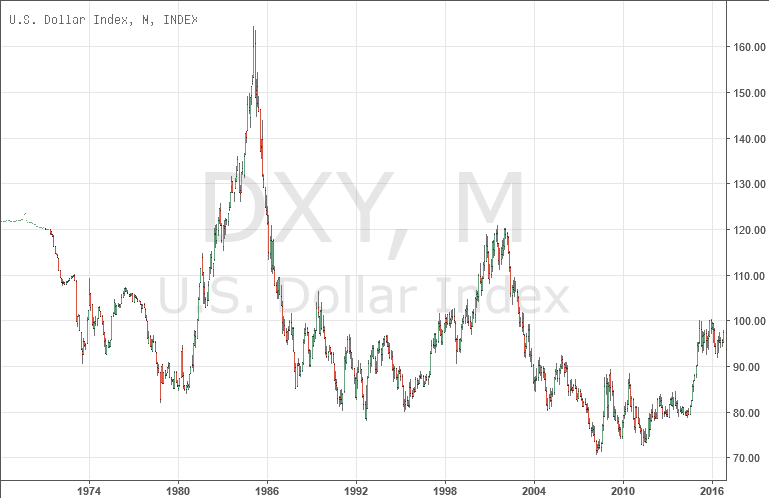
Long-term chart of US dollar index (DXY) from 1971 through 2016
At the beginning, the value of the US dollar index was 100. Since then, it has traded at a high of 164.72 (February 1985) and at a low of 70.698 (March 2008).

Math behind the US dollar index

The formula for the calculation of the US dollar Index is as follows:
DXY = 50.14348112 × EURUSD -0.576 × USDJPY 0.136 × GBPUSD -0.119 × USDCAD 0.091 × USDSEK 0.042 × USDCHF 0.036
If the US dollar is the base currency in a pair, then the weighing coefficient is positive. On the other hand, if the US dollar is the quote currency, then the coefficient of that pair would be negative.

Interpretation

The value of the US dollar index enables a trader to understand whether the US dollar has strengthened or weakened against the basket of currencies and by how much. If the US dollar index trades at 125, then it means that the greenback has appreciated by 25% against the basket of currencies compared to the initial value. Likewise, if the US dollar index trades at 75, then it means that the greenback has depreciated by 25% against the basket of currencies. So, when the US dollar index is in a clear uptrend, a Forex trader should avoid taking a short position in the US dollar based currency pairs and vice-versa.

Trading the US dollar index

The US dollar index futures contracts are traded on the Intercontinental Exchange (ICE). The US dollar index is the most widely recognized and traded currency index. The futures contracts were first offered for trading on November 20, 1985. From September 3, 1986, the US dollar index options were made available for trading. Both futures and options are available exclusively for trading electronically on the ICE platform. The exchange symbol for the futures contract is DX (SDX for mini futures contracts) followed by the month and year code.
The quotes are updated once every 15 seconds using multiple Forex data feeds. The midpoint of the top bid/ask price is used for the calculation of the US dollar index and is passed on to different data vendors. Some of the data vendors use their own symbol. For example, Bloomberg uses the symbol DXY (commonly referred to as Dixie). Trading in the contract starts at 18:00 EST on Sunday and ends on 17:00 EST Monday. The market re-opens again at 8:00 EST and closes at 17:00 EST on Tuesday through Friday. Similar to other exchanges, the traders can place orders during the pre-open period (30 minutes before the trading/execution of orders begin). The derivative contracts enable an investor to hedge his portfolio against the volatility risk of the US dollar.  The US dollar index ICE contract is the only USD futures contract which is publicly traded in a regulated exchange and offers a transparent price discovery mechanism. Based on the personal capability, variations of the US dollar index are privately traded by the hedge funds and high net worth investors with the investment banks.
The size of the US dollar index futures contract is $1,000 times the index value. For example, if the US dollar index is trading at 96.550, then the size of the contract is $96,550. The tick size is 0.005 ($5 worth). The contracts have quarterly expiration cycle - March, June, September, and December. Daily settlement is based on the volume-weighted average price of all the transactions executed during the closing period (14:59–15:00 EST). Even though the tick size is 0.005, the settlement price is expressed in 0.001 increments.
In general, the futures contract of the US dollar index is stated to be offered by the New York Board of Trade (NYBOT), which is a subsidiary of the ICE. The DXY is also traded as ETFs and mutual fund units through various exchanges.

Trade-weighted US dollar index

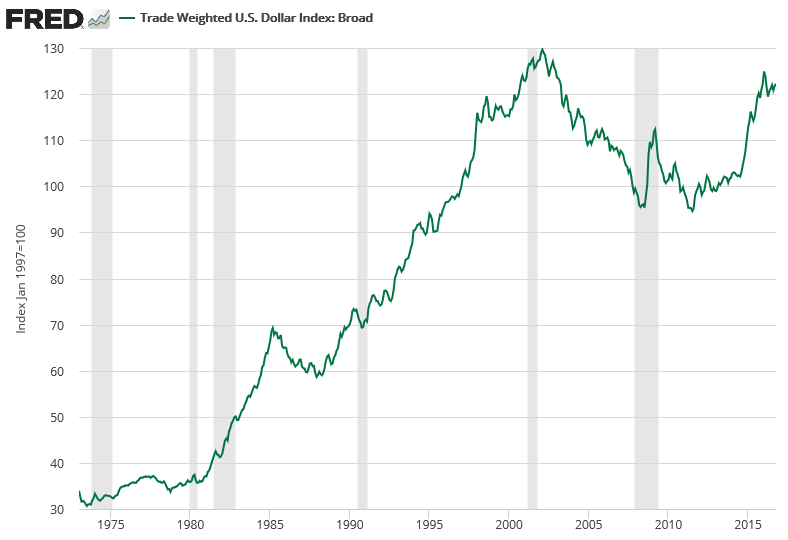
In order to make the index relevant to the current economic situation, in 1998, the Federal Reserve created an alternative to the US dollar index. Firstly, there was a need to include the currencies of countries such as Brazil, China, and Mexico, which were gaining prominence in the international trade with the USA. Secondly, the arrival of the euro made it a necessity for the creation of an alternative to the existing US dollar index. The newly created index was referred by the name trade-weighted US dollar index or Broad Index.
Fed's Trade-Weighted Dollar Index (Broad) - Long-Term Chart
As mentioned earlier, the index was primarily created to assess the strength of the US dollar in an accurate manner. The weightage of the currencies used in the calculation is based on the volume of imports and exports between the United States and the respective countries. The trade data is used to update the weightage of the currencies once a year. The trade-weighted US dollar index is updated once a week. It is not available for trading. The currencies that were used for the creation of a trade-weighted US dollar index and the corresponding weightage as of October 26, 2015 were as follows:
Eurozone16.638
Canada12.664
Japan6.462
Mexico12.119
China21.562
United Kingdom3.322
Taiwan2.387
Korea3.929
Singapore1.665
Hong Kong1.328
Malaysia1.536
Brazil2.052
Switzerland1.804
Thailand1.381
Philippines0.572
Australia1.23
Indonesia1.007
India1.991
Israel1.01
Saudi Arabia0.957
Russia1.37
Sweden0.654
Argentina0.55
Venezuela0.33
Chile0.793
Columbia0.687

Math behind the trade-weighted US dollar index

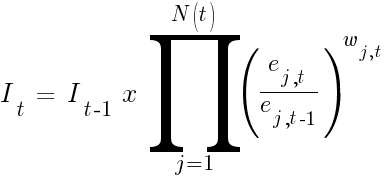
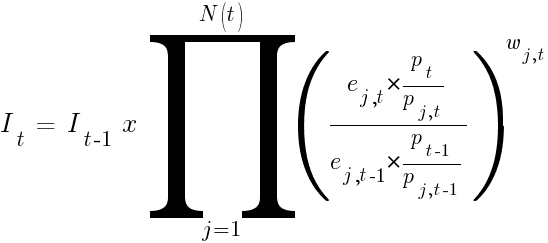
The trade-weighted US dollar index can be calculated using the nominal exchange rates (the rates provided by a Forex broker) and the real exchange rates. The formula for calculating the US dollar index using the nominal exchange rates is as follows:
 — value of index at time .
 — value of index at time .
 — number of currencies in index at time .
 — exchange rate of currency  at time .
 — exchange rate of currency  at time .
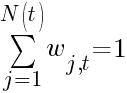
 — weight of currency  at time  and:
Before looking at the other formula, it is better to understand what a real exchange rate is. A real exchange rate takes into account the difference in the inflation rate that exists between the United States and the other country. The real exchange rate calculation is done using the prevailing Consumer Price Index (CPI) values. So, the formula for calculating the US dollar index using the real exchange rates is as follows:
 — US consumer price index at time .
 — US consumer price index at time .
 — value of the country  consumer price index at time .
 — value of the country  consumer price index at time .

Other variants

From the currency composition and the corresponding weightage, it can be easily understood that the US dollar index no longer reflects the current situation. The ICE also charges a considerable amount for the real-time and delayed quote feed.
Furthermore, the weighted geometric mean used for the calculation of the US dollar index makes it costlier for the market makers. Moreover, the US dollar index chart looks more or less like an inverted euro dollar chart. Finally, the difference in weightage means that the euro’s impact on the US dollar index is larger than other currencies, even though it may not be the case always (for example, another round of monetary easing by the ECB and BoJ will not create a similar impact on the value of the US dollar index).
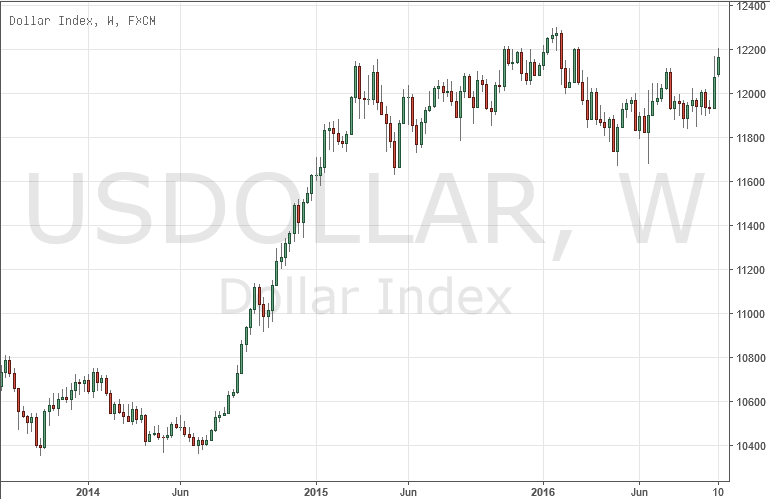
Considering the above mentioned disadvantages, the Dow Jones and FXCM created the DJ FXCM Dollar Index. The DJ FXCM Dollar Index is made up of four major currencies – the euro, the yen, the aussie, and the pound. Each of the four currencies is given a 25% weightage. The system enables a trader to perfectly track a position in one of the four currencies with relative ease by simply watching the DJ FXCM Dollar Index. The index can be traded on the trading platform offered by the Forex broker FXCM.
FXCM Dollar Index - Weekly Chart

Conclusion

The US dollar index can be used as a quick reference guide to assess the strength of the US dollar against the rival currencies. However, considering the huge investment required, it is arguably suited only for large traders. Still, it is worth to check out the index chart before entering into a trade as it will assist in avoiding wrong entries.

10 Drawbacks of Harmonic Pattern Trading

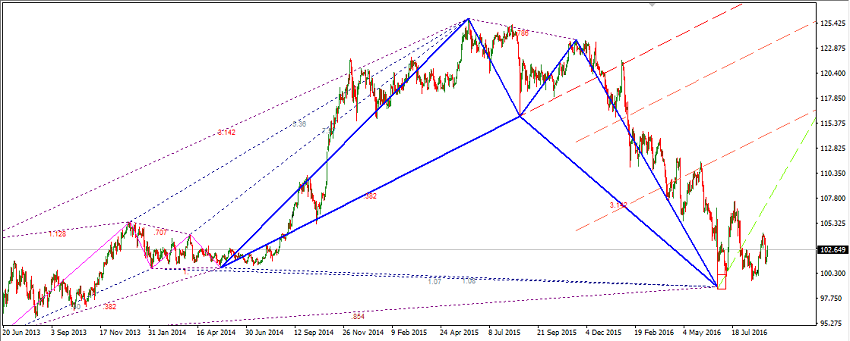
The price of any asset traded in a financial market moves in cycles. The cycles tend to repeat themselves and form geometric patterns. Studies revealed that the legs, which form these unique geometric patterns, are related to each other through Fibonacci ratios. Each of these patterns is referred by a name, usually that of an animal, based on their appearance in a chart. Since these patterns develop naturally, they are referred to as harmonic patterns.
Harmonic patterns enable a trader to identify the price level at which the trend of an asset can probably undergo a reversal. Thus, it gives early entry advantage to a trader as long as the forecast turns out to be true. However, similar to any other trading system, harmonic pattern has its own share of disadvantages. This article discusses the most important drawbacks of harmonic pattern trading.

1. Too many patterns

The legs that make up the harmonic pattern share a particular Fibonacci ratio with each other. If there is only a single pattern, then a trader may be able to remember the ratios. On the contrary, there are at least half a dozen harmonic patterns (Bat, Butterfly, Crab, AB=CD, Gartley, etc.) Thus, it becomes difficult for a trader to study, remember, and identify those patterns without using specialized software or indicators. Additionally, the trader will find it difficult to spot the harmonic pattern that not only has a high probability of success but also offers admirable gains.

2. Contradicting signals

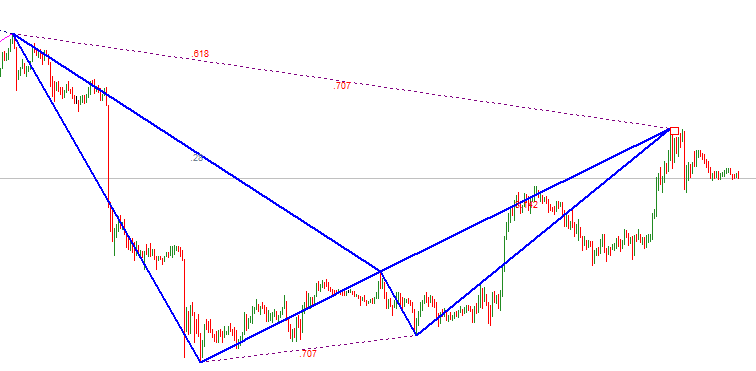
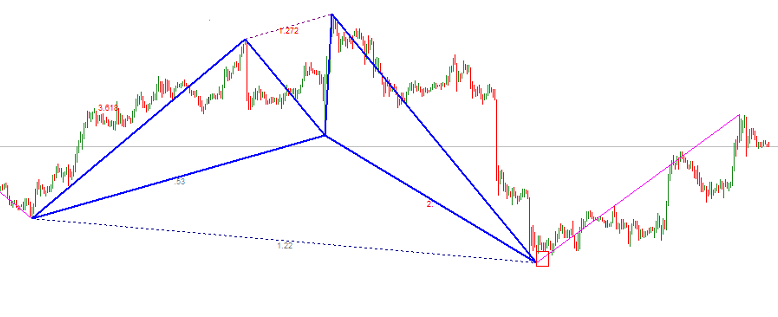
It is the most common problem faced by beginners. Harmonic patterns, which develop in different timeframes, may show conflicting signals. We may see a bullish and bearish pattern in two immediate timeframes. This may create confusion in the minds of a trader. The USD/JPY chart below shows a bearish total harmonic pattern in the 15 minute timeframe and bullish shark harmonic pattern in the 30 minute timeframe. In such circumstances only prior trading experience will enable a trader to assess the situation and take a proper trading decision. Mere knowledge of harmonic pattern will not be sufficient:
Bearish Total harmonic pattern
USD/JPY - Bearish Total harmonic pattern on M15 timeframe.
Bullish Shark harmonic pattern
USD/JPY - Bullish Shark harmonic pattern on M30 timeframe.

3. Higher chances of hitting stop-loss

Traders who piously follow the rules of harmonic pattern trading would vouch for its precise entry and stop-loss levels. However, it can be understood that the entry and stop-loss rules are prone to easy manipulation by major players and can become a major drawback. In a Forex market, a few more pips deeper into the Potential Reversal Zone (PRZ) would be more than sufficient to trigger the stop-loss orders quite easily during volatile periods.

4. Predicting extensions

Even though harmonic patterns are generally perceived to have a fixed set of trading rules, it is not the case always. In several harmonic patterns, the legs that make up a pattern can have extensions. For example, in a simple alternative AB=CD pattern, the length of the leg CD can be either 1.27 or 1.618 times the length of the AB leg. In such circumstances, seasoned professionals calculate the probable length of the CD leg by studying the BC leg. It is needless to say that only experience can teach those techniques to a trader thereby liquidating the whole concept of making smart decisions simply by learning the harmonic patterns.

5. Timeframe

Harmonic patterns only deal with ratio between price swings. It does not speak anything about the timeframe to choose or the time needed to achieve or violate a particular pattern. Furthermore, harmonic patterns are mostly used by swing traders. The harmonic pattern trading is not suited for short-term timeframes and day trading in general.

6. Purely technical

Harmonic patterns are based on the assumption that human beings tend to repeat their past behavior even without their own awareness. If the fundamentals of an asset change in a drastic manner, then it is certain that the pattern will fail. A professional currency trader should certainly give importance to the fundamentals which strengthen or weaken a currency. When a large number of traders place a buy or sell order just because a pattern indicates a reversal at a particular point, then it becomes a self-fulfilling prophecy. A smart fund manager can easily take away their stops in no time. While there is no denial that short-term fluctuations cannot be explained always through economic data, still, placing a buy or sell order purely based on a harmonic pattern is certainly not a smart decision.

7. Pattern can morph into another

There is no guarantee that a harmonic pattern may complete as expected. One of the legs can extend thereby resulting in a failure of the pattern. Furthermore, the pattern can also morph into another pattern. Let us assume that a Gartley pattern is developing in the price chart. For a perfect Gartley pattern, the leg AB should be equal to the leg CD. However, the slope of the CD may not be equal to that of AB. Let the recent swing high be represented by X. Then, for a harmonic Gartley pattern, the point B and point D should not exceed X, while the point C should not exceed A.   If the point D exceeds X, then the pattern becomes a failure. Additionally, the pattern can morph into a Butterfly harmonic pattern. Such a possibility will keep a beginner trader in dilemma.

8. Issues with Potential Reversal Zone (PRZ)

There PRZ of certain harmonic patterns is made up of a culmination of several Fibonacci ratios. The issue is that the levels indicated by the Fibonacci ratios may be spread over 50 pips or more. For example, the ratios that make up the PRZ in a Gartley pattern are 0.786 XA, 1.27 BC, and 1.618 BC. Furthermore, the level where AB=CD may also end up in the PRZ.  Thus, it is not possible to place an order straight away and wait for the price to reach the PRZ. A retail trader has to constantly monitor for the formation of higher lows or lower highs to enter a long or short position. This makes the harmonic pattern based trading a complex process.

9. Clumsy charts

The price chart will have a clumsy look whenever a harmonic pattern indicator is attached to the chart. Seasoned traders always advise beginners to have a clean price chart so that support and resistance levels can be clearly seen. Having numerous lines on the price chart can divert a trader’s focus from important levels.
Cluttered chart
Too much chart noise due to harmonic pattern markup.

10. No dearth of new patterns

There is no dearth of claims of new harmonic patterns in the internet. Nearly all of them vary only in a minor manner from the six main harmonic patterns. In fact, such claims add to the complexity of trading the harmonic patterns further.
There is no doubt that harmonic patterns offer a degree of advantage to a trader. Still, practical experience and sticking to the rules, as proven by Turtle traders, is by far the most important to succeed in trading.

Spread Betting vs. Forex Trading

Differences Between Spread Betting and Forex Trading

While some people think that spread betting and Forex trading are very similar, in fact there are a number of important differences between the two that need to be understood. Perhaps the most important difference between the two types of transactions is that spread betting is recognised as a form of gambling under the law of the United Kingdom while Forex trading is officially recognised as a form of speculative investment. Although there are many similarities between the two thing, the official gambling status of spread betting means that there are tax implications that stand to benefit the investor.

Tax Free Profits

When dealing in any form of official financial speculation, such as Forex trading, the investor must pay tax on their profits. Although these sums may seem small on each transaction, they will eventually add up and for the serious trader can end up being a large amount at the end of the year. Spread betting is a little different as the trader never purchases any kind of futures contract but is instead placing a wager as to which way they believe the market is going to move. As there is no physical sale or purchase and because spread betting is officially gambling under UK law, this means that there is no Stamp Duty or Capital Gains Tax to pay on any profits and this results in the investor being permitted to keep 100% of the money that they have earned. This obviously is very attractive to the investor and substantially benefits traders who choose this type of transaction. The tax exemption only works if spread betting is not the main source of income for a person.

Commission

In spread betting, there is no commission to pay on any transaction as the spread betting provider makes their profit from the difference between the bid and the ask prices. This is also the case with spot Forex, as the brokers typically charge commissions only on their Electronic-Communication-Network (ECN) accounts. Similar to spread betting, spot Forex transactions are monetized by the spread markup.

Breadth of Markets

While Forex trading is specifically referring to the trading of currency pairs to make profit, spread betting in its widest form allows instant access to more than 12,000 worldwide financial markets from shares to commodities. It also even offers investors the opportunity of accessing unusual markets such as house prices, sporting events, or even political events. Of course, for those who prefer to trade in currency pairs, this can also be done through spread betting.

Islamic Law

One important difference between spread betting and Forex trading is that spread betting is considered to be a form of gambling, and therefore is not acceptable under Muslim laws. Forex trading, on the other hand, can be carried out under Islamic law and most brokers offer the opportunity for Muslim traders to open a special Islamic account to enable them to take advantage of this type of trading.

Legality

Spread betting has a smaller geographical coverage, this is for certain. It is, perhaps, most widespread in the UK and Ireland, but it also gets quite some traction in Canada. However, spread betting is banned nationwide in the country where it was invented - the United States. There are a few reasons for this, the main one is, of course, its biggest advantage – tax-free profits. Next to the USA, there are a few more countries where Forex trading is allowed but spread betting is banned. One of such examples is Japan, a country where online betting is only allowed for for lottery, soccer toto, and public sport. Other countries, like Australia, have recently allowed spread betting, but it does not come with tax exemptions. Typically, spread betting will always be illegal in the countries that prohibit online gambling and betting.

Similarities of Forex Trading and Spread Betting

While there are several differences between the two types of financial transaction, there are a number of similarities too between Forex trading and spread betting.

Leverage

Both Forex trading and spread betting are leveraged products, meaning that the investor is only required to place a small amount of the entire value of their position. Investors must remember, however, that their exposure will be much greater than the amount outlaid, and while leverage offers the potential to make bigger gains, it also means that there is a much greater potential for big losses if the markets do not move according to expectations. Spread betting providers may offer higher leverages than Forex brokers and, while this can be good news for the experienced investor, it can also lead to financial trouble for those who have a poor understanding of how leverage works and insufficient knowledge to know how to use it properly.

Platforms

Spread betting and Forex trading are carried out on the same trading platforms using the same interfaces. This means that both are equally easy to do as the interfaces are user-friendly and designed to accommodate the needs of traders both experienced and novice. Many brokers offer both Forex trading and spread betting on their websites meaning that it is easy for investors to try their hand at both types of investment without having to register with another site.

Profiting in a Falling Market

Both Forex trading and spread betting allow the trader to profit in any type of market, whether it is rising or falling. In the case of spread betting, a trader only predicts whether they think the market for their chosen asset will rise or fall, so it makes no difference what moves the market actually makes as long as their prediction turns out to be correct. Similarly, in Forex trading, it is possible to make a profit whether the market goes up or down depending on whether the investor chooses to buy or sell.

Should a Trader Choose Spread Betting Over Forex Trading?

While Forex trading is considered to be a serious form of financial transaction and is officially a type of speculative investment, spread betting does not enjoy the same reputation. Officially a type of gambling, those who are looking for a serious investment may not wish to consider spread betting. However, there are excellent financial reasons for doing so. Spread betting offers spreads which are similar to those offered by Forex brokers, however the key difference is the tax which is levied on it. Many traders prefer spread betting over traditional Forex trading as they believe that there is no benefit in using an FX broker if the spread offered is the same as that offered through a spread betting provider. This is because in the Forex transaction they would be obliged to pay tax on their earnings, whereas during spread betting, there is no tax obligation to be paid.

Which Is Better? Forex Trading or Spread Betting?

It is difficult to say which of the two trading types are better, and there are different circumstances in which each would be the best choice. An important point to consider is that not every top Forex broker will offer spread betting to its clients in the first place. The advantage of Forex trading over spread betting includes its compliance with Islamic law, which is an obvious benefit for Muslim investors, as well as its recognition as a reputable and serious form of investment, however spread betting has the edge financially, because of its tax implications. The attraction of having no Capital Gains or Stamp Duty taxes to pay on profits often draws in increasing numbers of UK investors.

Comparison of MT4 and MT5 Trading Platforms

The MetaTrader 4 and MetaTrader 5 platforms from MetaQuotes Software Corporation are recognized leaders among the Forex trading software. The fifth version of the terminal was launched in 2010. Since that time, it has been changed and upgraded several times. MT4 platform appeared in Forex brokers' accounts in July 2005. Currently, both software products develop independently. So, what are the main differences of the 5th and 4th versions of MetaTrader?

Design

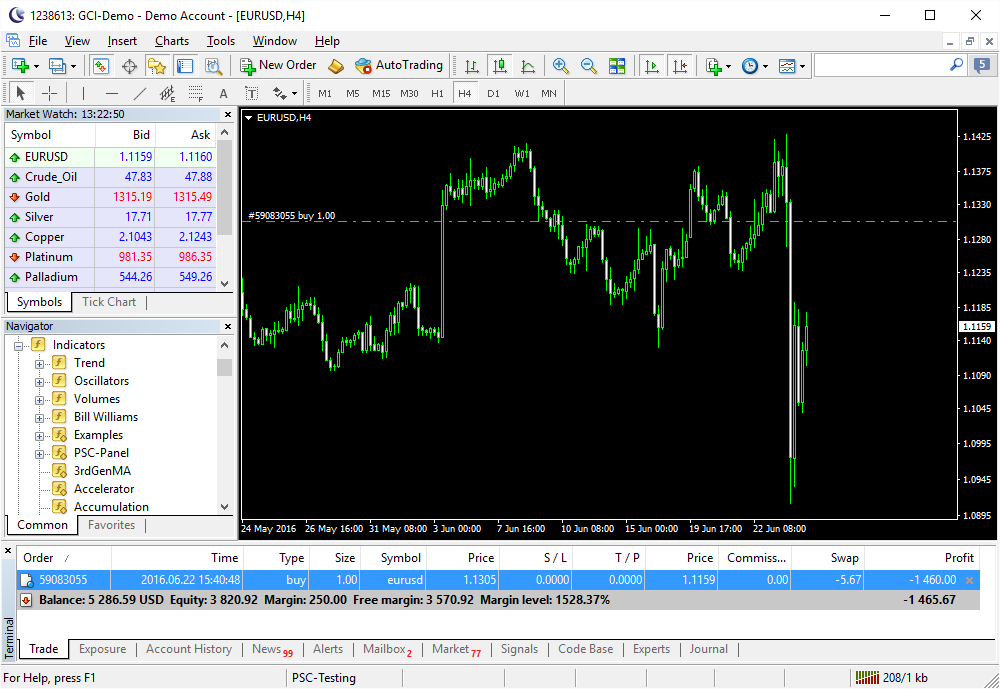
From the design point of view, MT5 looks very similar to its predecessor. The workspace of MetaTrader 5 is divided into the same logical parts as MT4: Market Watch, Navigator, Trading, and the financial instrument's Chart.
The changes have been made only to the design of some buttons. Contextual menu has been updated to offer chart type switching between line, bars, and candles. A layman would not tell any difference between MetaTrader 5 and MetaTrader 4 at a first glance. Visual distinctions are almost absent.
MT4 terminal's workspace looks like this:
MT4 platform design
5th version's design is nearly the same:
MT5 platform design

Timeframes

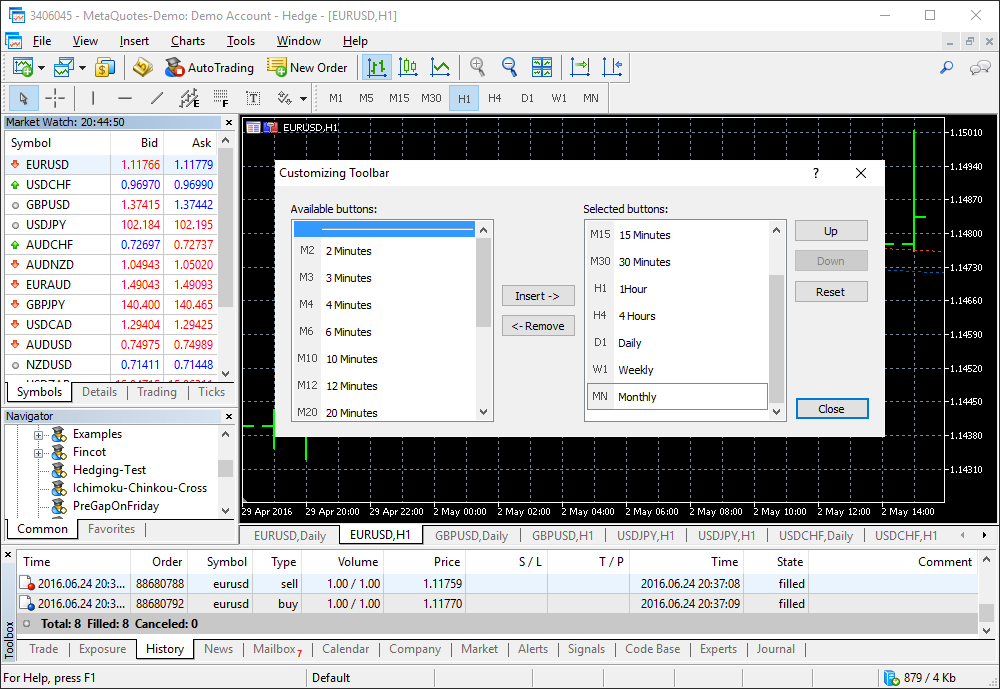
MT5 trading platforms offers 9 standard timeframes: M1, M5, M15, M30, H1, H4, D1, W1, and MN. The assortment of time periods in MT5 terminal is much wider. In addition to the timeframes presented in MT4, the 5th version boasts the following ones: M2, M3, M4, M6, M10, M12, M20, H2, H3, H6, H8, H12.
In MT4 platform, you would need to use a special script to show non-standard timeframes on the chart. In MT5, you can just configure them for the top control panel:
Adding new timeframes in MT5

Trading

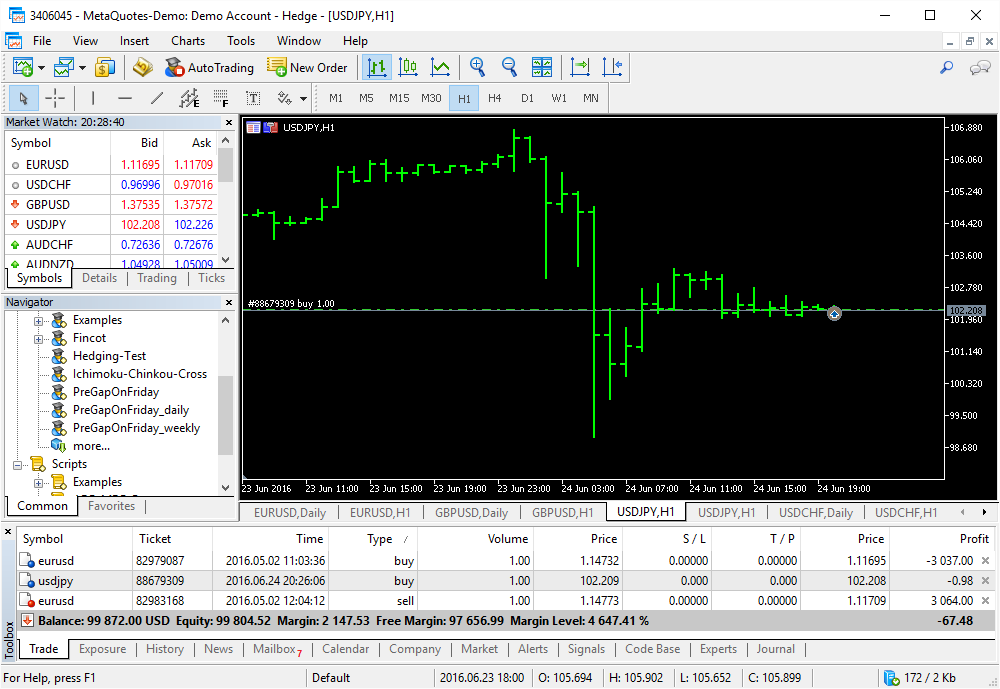
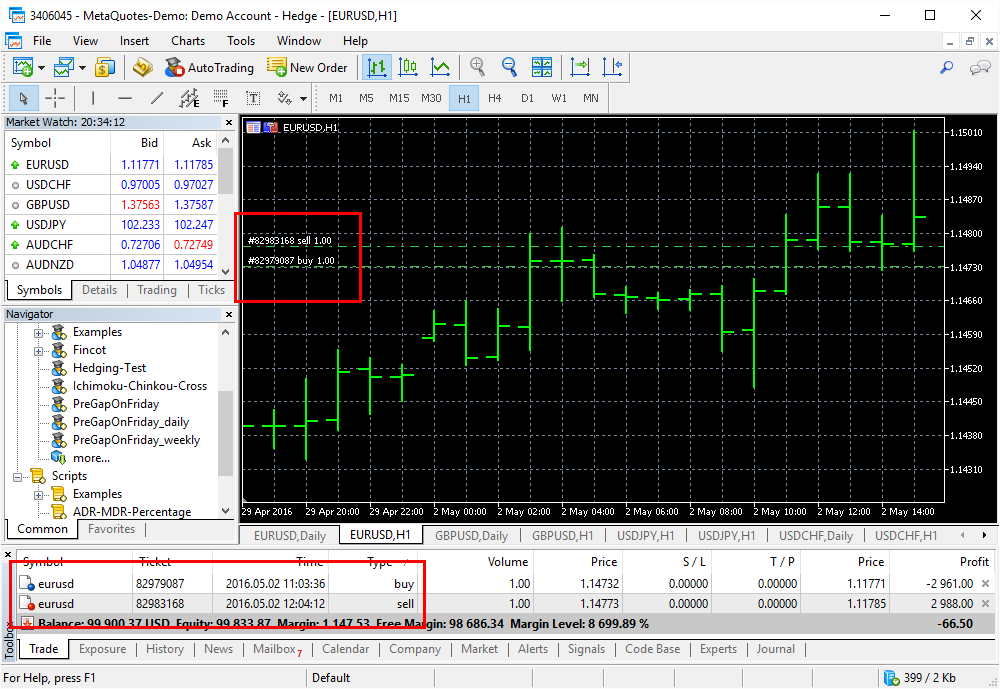
Previously, MT5 did not support position hedging. A trade executed in an opposite direction would close (partially or completely) the existing position. During platform's update in April 2016, MT4-like hedging has been introduced into MetaTrader 5.
Hedging positions in MT5
At the same time, traders can still open accounts, which use netting position system (without hedging) at MT5 brokers.
In hedging mode, the trading account will show all positions opened for the same trading instrument at different prices and different time. In netting mode, such positions would be aggregated together. The terminal would be showing average price and net volume.

Order management

In the latest version of MetaTrader, you can drag-and-drop the stop-loss and take-profit levels with your mouse. This feature works in normal mode and in One Click Trading mode. The difference is that the former requires manual confirmation for each SL or TP change while the latter means instant change of the respective trading levels.
In MT4 terminal, this feature works only with One Click Trading mode turned on. The price change is instant. MT4 and MT5 work similarly in this regard. However, if One Click Trading is turned off in MT4, the order modification is more diffic

Saturday, September 12, 2015

Currency Trading Is Not The Monopoly Of The Nerds And The Geeks

The general perception is that any and every person who is involved in the business of trading of currency or foreign exchange is a person who has a super high IQ

Thursday, September 10, 2015

Shoes Or Forex?

Most people, who want to establish a financially-secure future, choose to start their own business by trading goods like shoes, art, crafts, clothing or antiques.

Your Mother Could Make Money In Forex Trading

The question would be not whether she could but rather would she enter the Forex trading market.

Forex Trading — Opportunities for Individuals

Forex Trading-How Can Individual Investors Benefit?
Indeed large multinational and individual banks and other major financial institutions have dominated FX trading (also known as Forex trading), but there is a paradigm change in the nature and type of investing.

Forex Made Easy for Everyone

Forex made easy is as simple as you would want it to be. The foreign exchange market is a worldwide market and according to some estimates is almost as big as thirty times the turnover of the US Equity markets.